EV charging station installation cost in the US runs from about $2,300 per AC port to $210,000 or more per high-power DC port in 2026. Hardware is rarely the biggest line item. Site conditions, electrical infrastructure, and permitting decide most of the budget. This guide breaks down what you’ll pay by charger type, what drives the numbers, and how to keep them under control.
We watched a hotel operator in Southeast Asia budget $8,000 per commercial AC port, only to discover mid-project that the site needed a full panel upgrade. Final cost: $14,500 per port. The hardware price never changed. The electrical infrastructure and site preparation costs did.
Key Takeaways
- Installed cost is dominated by infrastructure, not hardware: an AC port lands at $2,300 to $10,450, and a high-power DC port can reach $210,000+.
- China factory-direct hardware runs $300 to $450 for a 7–22 kW AC charger and $5,200 to $9,500 for a 20–360 kW DC fast charger. The 5 m cable is standard.
- The biggest budget risks are panel and service upgrades ($1,500 to $50,000+), trenching ($50 to $200 per linear foot), and utility timelines (up to 18 months).
- Section 30C expired June 30, 2026, and no extension is pending. New US projects budget around NEVI, state rebates, and utility programs.
- Six or more ports at once, plus load management, cuts per-port installation costs by 30% to 50%. Cheap hardware that fails early wipes those savings out.
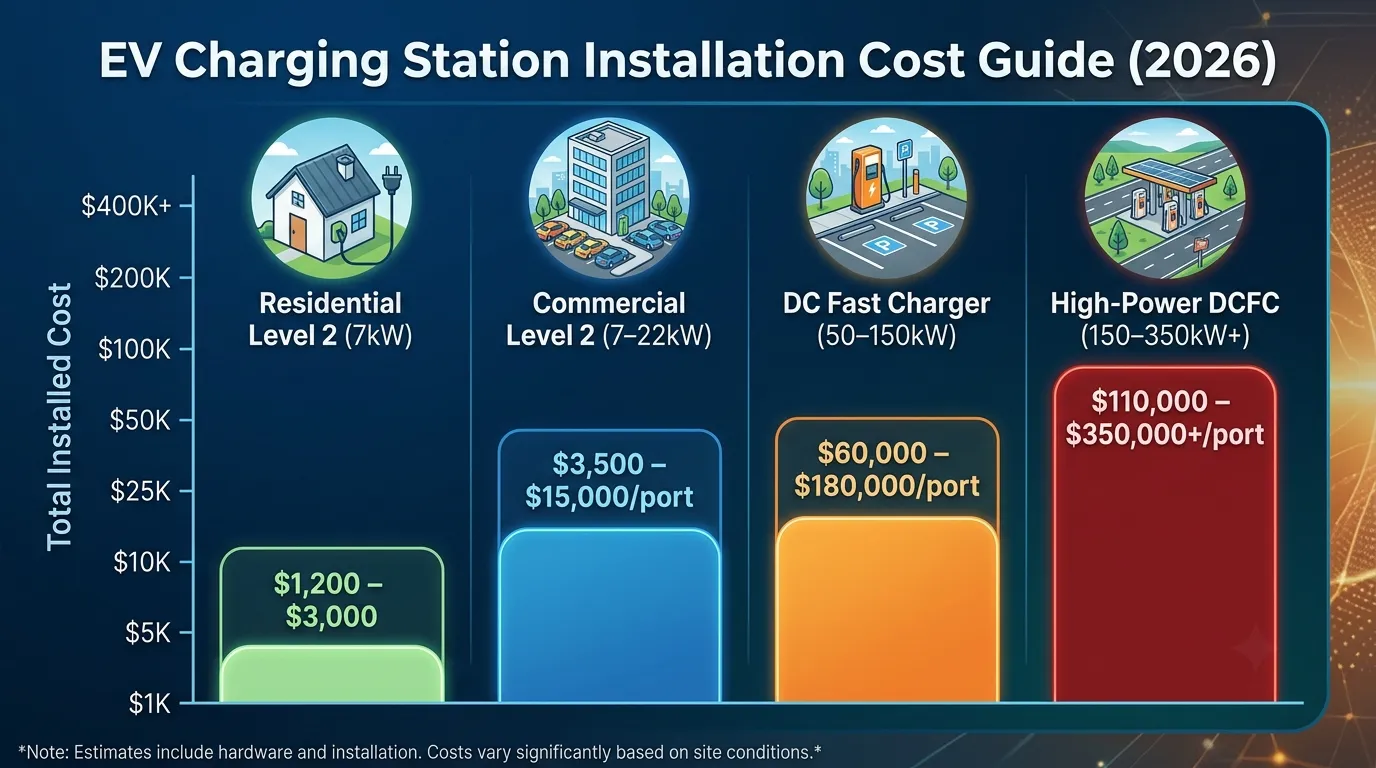
EV Charging Station Installation Cost by Charger Type
Commercial EV charging stations run on 7–22 kW AC chargers and 20–360 kW DC fast chargers. In 2026, China factory-direct hardware costs $300 to $450 for an AC unit and $5,200 to $9,500 for a DC fast charger. Installed costs are another story: roughly $2,300 per AC port up to $210,000+ per high-power DC port, as the table below details.
| Charger Type | Hardware (China direct) | Installation | Total Installed |
|---|---|---|---|
| AC Charger, Level 2 (7–22 kW) | $300–$450/unit | $2,000–$10,000/port | $2,300–$10,450/port |
| DC Fast Charger (20–150 kW) | $5,200–$9,500/unit | $40,000–$120,000/port | $45,000–$130,000/port |
| High-Power DCFC (150–360 kW) | $5,200–$9,500/unit | $50,000–$200,000+/port | $55,000–$210,000+/port |
Reading the table: hardware figures are China factory-direct, single-unit prices and assume the standard 5 m charging cable. Lower power ratings sit near the bottom of the DC range; 150–360 kW units sit near the top. Installation covers electrical work, trenching, permits, and site preparation, and it dominates the total on most projects.
Looking for a project-specific estimate? Use Klitv’s ROI Calculator to model your costs and payback period, or contact our team for a custom quote.
Level 1 Is Not Used in Charging Stations
Level 1 equipment plugs into a standard 120V household outlet and delivers only 1.2 to 1.4 kW, or roughly 3 to 5 miles of range per hour. It’s essentially never specified for a commercial charging station: dwell times are far too long and revenue per port is too low. Station operators choose 7–22 kW AC chargers for workplace and destination parking, and 20–360 kW DC fast chargers where quick turnaround matters. Level 1 belongs to residential and portable use cases, not station deployments.
AC (Level 2) Charger Installation Cost: 7–22 kW
An AC charger, Level 2 in US terms, runs on 240V single-phase or 380V three-phase supply and delivers 20 to 30 miles of range per hour at 7, 11, or 22 kW. China factory-direct hardware costs $300 to $450 per unit, the lowest equipment price of any station-grade charger. Commercial installation adds $2,000 to $10,000 per port for conduit, cable, and panel work. A single residential unit is simpler to wire at roughly $800 to $2,200, so a home EV charger installation cost lands around $1,100 to $2,700 all in. Total commercial installed cost: $2,300 to $10,450 per port.
Klitv’s 7–22 kW AC charger suits home, apartment, and office installations as well as hotel, retail, and open-air public parking, with 7 kW, 11 kW, and 22 kW models on one platform. Our 60–80 kW DC fast chargers serve retail centers and commercial parking lots where faster turnaround matters.
DC Fast Charger Installation Cost (20–360 kW)
Hardware is only part of the cost. A 20 to 360 kW DC fast charger (DCFC) runs $5,200 to $9,500 factory-direct from China, with higher-power units at the top of the range. Installation, however, typically costs $40,000 to $120,000 per port in the 20–150 kW class. The main cost drivers are high-voltage service, trenching, utility interconnection, and specialized electrical labor. Interconnection queues alone stretch 6 to 18 months depending on the utility, which is why early planning is essential.
Still weighing AC against DC for your site? Our DC vs AC charging guide walks through the trade-offs.
For high-traffic hubs and highway service areas, Klitv’s 120–240 kW DC charging stations deliver rapid charging with durable construction built for 24/7 operation.
High-Power Charging (150–360 kW)
At the top of the station range, 150 to 360 kW installations typically run $55,000 to $210,000 or more per port once hardware and infrastructure are combined. These projects almost always need a dedicated pad-mounted transformer ($20,000 to $80,000 or more), heavier switchgear, and longer utility timelines. Site civil works scale up too: reinforced concrete pads, crash-rated bollards, and fire-safety clearances add another $5,000 to $15,000 per site. The charger hardware itself still stays within the $5,200 to $9,500 DC band.
For 360 kW and above, liquid-cooled hardware is the standard. Klitv’s 360–600 kW liquid-cooled supercharger platform covers highway corridor sites that expect heavy-duty, high-turnover traffic. Hardware cost per port peaks here; so does revenue per session. That’s why these sites often pencil out despite the steep entry price.
EV Charger Hardware Prices: What Is Included
When you import from China, the equipment quote sits apart from the installation quote. Two details decide whether the number you see is the number you pay: the price band for your power rating, and the cable length in the box.
- AC charger (7–22 kW): $300 to $450 per unit
- DC fast charger (20–360 kW): $5,200 to $9,500 per unit, with lower ratings near the bottom of the range and higher-power units near the top
- Charging cable: 5 m is the standard length in the Chinese market, and that length adds no extra charge
- OEM branding: standard printed logos on existing enclosures come at no charge; custom designs, colors, and firmware work are quoted separately
Cable length matters more than most buyers expect. Because 5 m is the domestic standard, ordering a station with a standard 5 m cable keeps you at list price. Longer or custom lengths are quoted separately and can extend lead time. A 5 m cable comfortably reaches the vehicle’s charge port from a well-placed pedestal in most parking layouts, so confirm the cable length on the quotation before you compare unit prices.
OEM work follows the same split. Printing your logo on a standard enclosure is usually free at the factory. Custom work is where fees appear: a new enclosure shape, brand colors, or a redesigned UI gets quoted line by line for engineering and tooling. Our OEM program lays out what each tier includes, and firmware/UI customization typically runs 7 to 14 days after specification sign-off.
These figures cover the charger and its standard cable only. They exclude shipping, import duties, local certification, and all site work. Treat them as the starting point of your budget, not the total.
What Drives EV Charging Station Installation Costs
Five factors drive most EV charging installation budgets: distance from the electrical panel, existing panel and service capacity, site preparation and permits, charger hardware, and local labor rates. Panel and service upgrades are the biggest budget driver. Trenching alone can add $5,000 to $20,000 on a 100-foot run.
Distance from the Electrical Panel
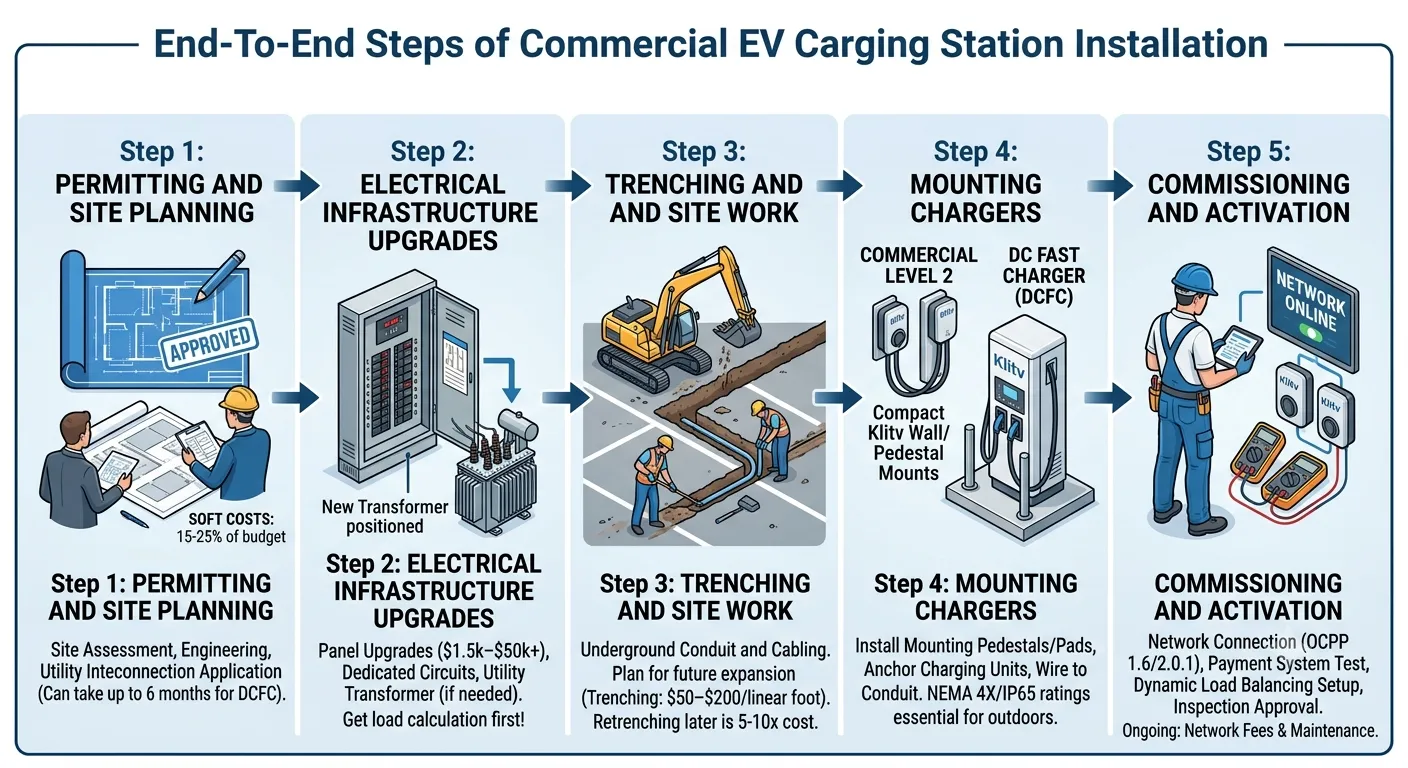
More distance between the panel and the charger means more conduit, more cable, and more labor. Trenching typically costs $50 to $200 per linear foot, depending on terrain and whether you’re cutting through asphalt, concrete, or soft ground. A 100-foot run can add $5,000 to $20,000 to your project. Whenever possible, position chargers close to your electrical service.
Electrical Panel and Service Upgrades
This is the number one budget killer, and the most common surprise. A residential panel upgrade typically costs $1,500 to $3,000. For commercial sites with multiple DCFC ports, a service upgrade can cost $10,000 to $50,000 or more. Sites drawing over 200 kW may need a dedicated utility transformer, which adds both cost and months to your timeline.
Get a formal load calculation from a licensed electrician before you order any hardware. It’s the cheapest insurance against mid-project budget overruns.
Site Work and Trenching
Most commercial projects need underground conduit in parking lots. Rocky terrain, existing utilities, and paved surfaces all increase complexity and cost. Plan conduit runs during initial construction rather than retrofitting later. Retrofitting costs 5 to 10 times more than laying conduit at build time.
If you’re building a new parking lot or renovating, run oversized conduit now for future expansion. A 4-inch conduit costs marginally more than a 2-inch conduit at initial build, but re-trenching later costs a fortune.
Permitting, Inspections, and ADA Compliance
Permit fees range from $50 to $800 depending on your jurisdiction. The US DOE Alternative Fuels Data Center notes that many regions now offer streamlined EV permitting, though high-power DCFC still faces longer review cycles. Research from the National Renewable Energy Laboratory confirms that soft costs like permitting and engineering can represent 15% to 25% of total project budgets for first-time deployers.
One line item buyers often miss is ADA-compliant parking stalls. Accessible charging spaces with proper clearance, striping, and bollards typically add $5,000 to $15,000 per site in the US. Many jurisdictions require at least one compliant stall per charging installation. Budget 2 to 6 weeks for commercial AC permitting and up to 6 months for DCFC.
Labor and Regional Rates
Licensed electricians in major US metros and Western Europe charge $80 to $150 per hour. In Southeast Asia or Eastern Europe, labor is cheaper, but EV-specific expertise may be scarce, which adds time and risk. If you’re deploying in a region with limited EV infrastructure experience, factor in extra time for contractor vetting and possibly flying in specialist support.
Commercial EV Charging Station Installation: Full Cost Stack
Hardware is typically only 10 to 25 percent of a commercial EV charging project’s total cost. On high-power DC sites it can fall well under 10 percent, because infrastructure dominates. The full stack includes one-time capital items (charger units, electrical installation, trenching, permits, site preparation) plus recurring network fees, maintenance, electricity, and demand charges, the lines that decide your payback.
One-Time Capital Costs
- Charger units and mounting hardware
- Electrical installation and panel or service upgrades
- Trenching, conduit, and cabling
- Permits and inspection fees
- ADA-compliant stalls, bollards, and site preparation
- Network commissioning and software setup
Ongoing Operating Costs
Sites that achieve 3-to-5-year payback periods are the ones that account for operating costs upfront, not just the installation invoice. For a commercial site, expect these recurring lines:
- Network and software fees: $100 to $400 per port per year for charging management software, payment processing, and support.
- Preventive maintenance: roughly 5% to 10% of hardware cost per year, covering cleaning, firmware updates, connector inspection, and component replacement.
- Electricity: your single largest recurring cost, set by local utility rates.
- Demand charges: utilities bill many DCFC sites a monthly demand charge based on peak power draw. A 150 kW charger can trigger thousands of dollars per year in demand charges alone. That’s why load management matters at high-power sites, and why some operators add battery storage to the mix (see below).
Battery Storage and Solar Add-Ons
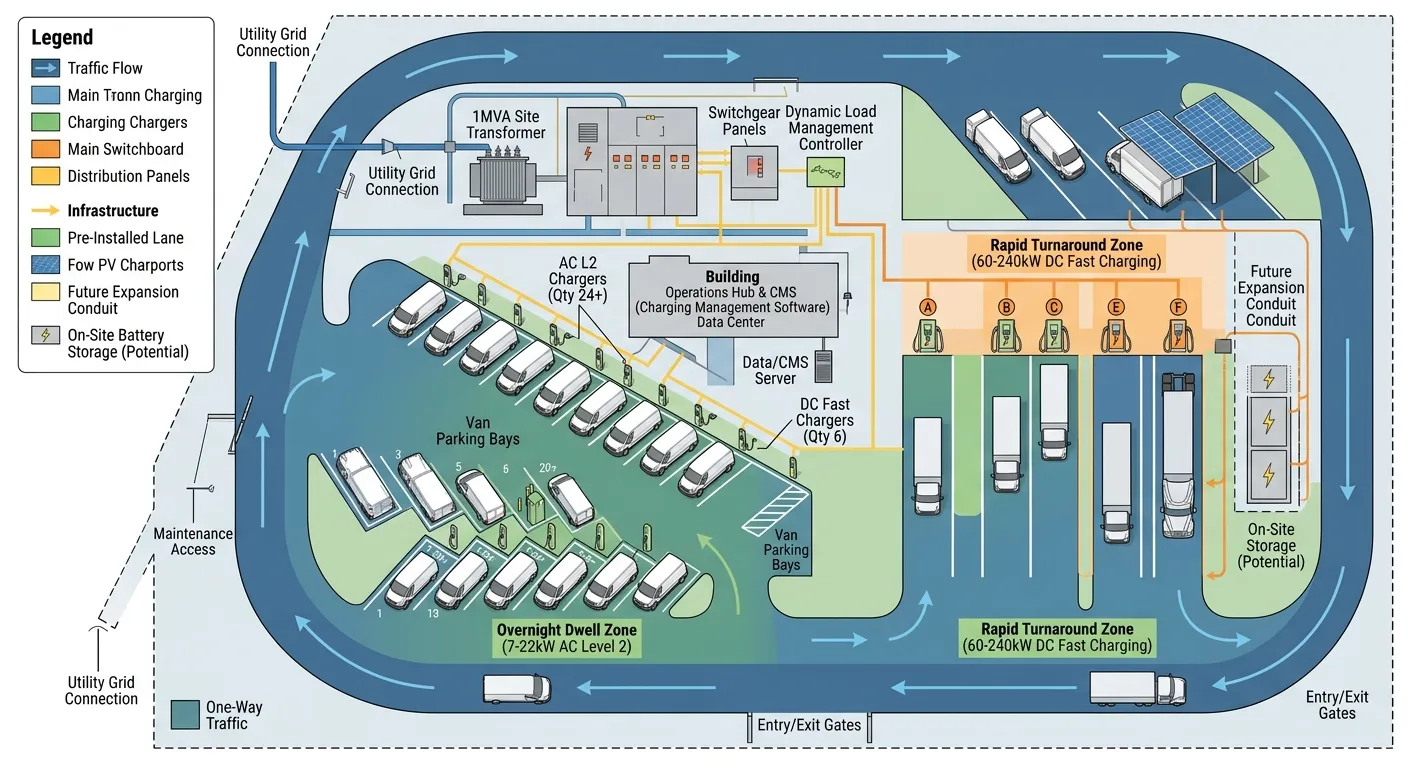
Some sites add two more capital lines: battery storage and solar. Both attack the same cost items, demand charges and the electricity bill.
- Battery storage buffers peak draw so high-power chargers don’t trigger demand-charge spikes. Illustrative 2026 numbers: turnkey commercial LFP storage in the range of $400 to $600 per kWh installed, so a 500 kWh buffer adds roughly $200,000 to $300,000 to the project.
- Solar canopies offset grid electricity and give you covered parking in the same structure. Installed commercial PV runs in the range of $2.50 to $3.50 per watt, so a 250 kW canopy is roughly a $625,000 to $875,000 line.
Whether either one pays off depends on your local electricity rates and tariff structure, not on the charger itself. Klitv chargers integrate with third-party storage and PV through OCPP and load management, so the charging layer doesn’t lock you into any storage or solar vendor. Model the combined system before committing; a 500 kWh buffer only earns its keep where demand charges or peak tariffs are high.
For a deeper look at charger selection, read our commercial EV charger guide.
For revenue modeling, utilization assumptions, and payback analysis once the station is live, read our EV charger hub profitability guide.
How Hardware Quality Affects Your Total Cost
Buyers who choose EV chargers on price alone routinely pay more over the equipment’s lifetime. Cheaper units fail faster in commercial use. Each failure adds replacement, labor, and lost-revenue costs that the initial savings rarely cover. Commercial-grade construction, weather ratings, and documented quality control reduce that risk.
A logistics company in Thailand chose lower-cost chargers for their fleet depot. Within 18 months, four units had failed from corrosion caused by humidity and temperature cycling. Replacement costs, including labor and project downtime, came to $3,200 per failed unit. The original savings on hardware were erased, and then some.
Klitv chargers are built with a 2.0mm thickened steel body and high-precision components with no recycled materials. This matters in real-world conditions: outdoor installations, coastal humidity, temperature extremes, and 24/7 operation. Every charger is packed in industrial-grade wooden crates for safe global delivery.
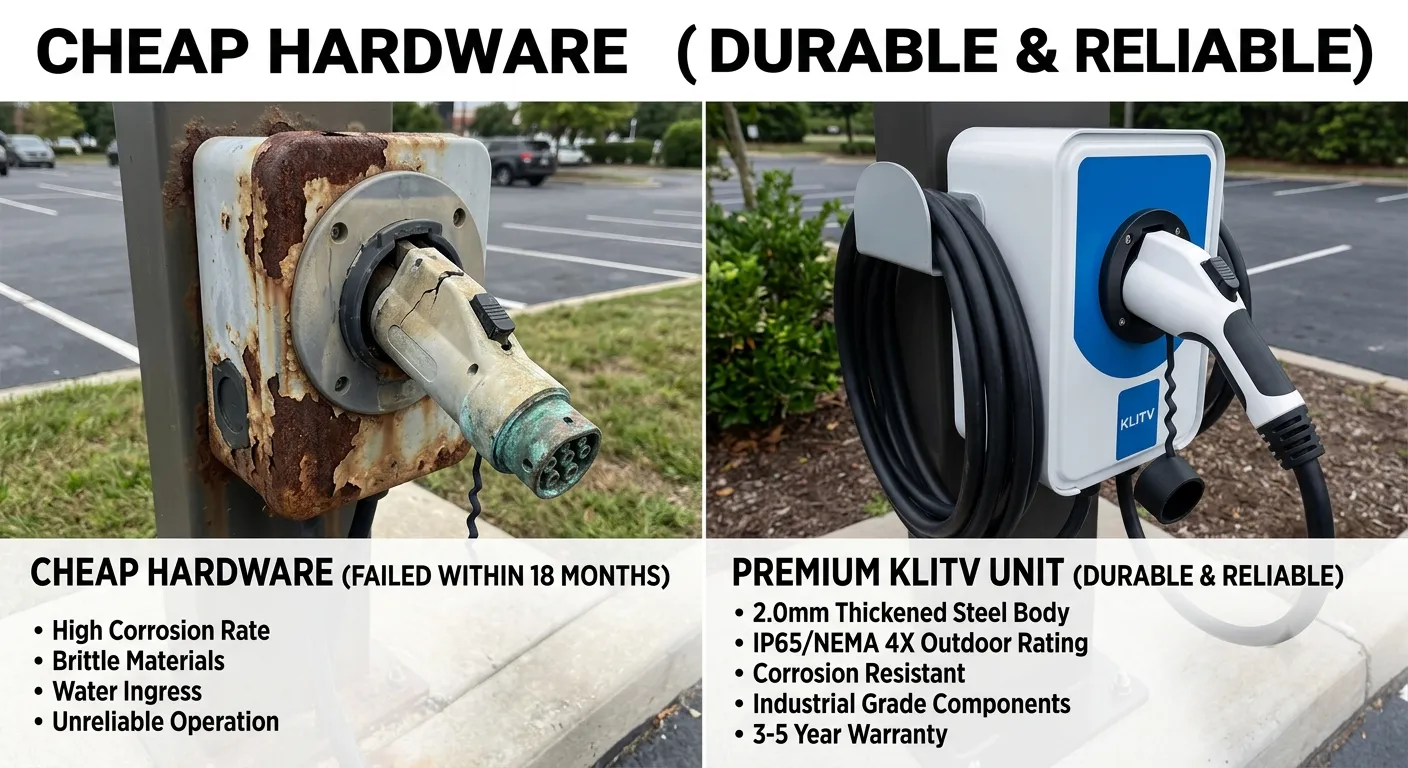
When evaluating hardware, look beyond the purchase price. Ask about:
- Corrosion resistance ratings (look for NEMA 4X or IP65 minimum for outdoor use)
- Warranty length and what it actually covers (parts, labor, shipping)
- Mean time between failures (MTBF) data from the manufacturer
- Availability of replacement parts and local service support
For a detailed breakdown of what to look for, see our EV charger certifications and safety standards guide. If you plan to launch your own branded line, review our OEM and private-label manufacturing options.
How to Reduce EV Charging Station Installation Costs
You can cut EV charging installation costs with four moves: deploy multiple ports at once to share fixed costs, oversize conduit for future expansion, use load management to avoid service upgrades, and phase construction around available grid capacity. Klitv clients have saved thousands of dollars per port with these.
1. Deploy Multiple Ports Simultaneously
Sites deploying six or more charging ports at once achieve significantly lower per-port installation costs. Fixed costs like permitting, trenching, and utility upgrades are shared across all ports. A single-port 120 kW DCFC installation might cost $90,000. Six ports at the same site rarely cost $540,000. With shared trenching, a single service upgrade, and one permit, the total is typically closer to $300,000 to $400,000, or $50,000 to $65,000 per port.
2. Plan Conduit for a 5-Year Buildout
Installing a 4-inch conduit at initial build costs marginally more than a 2-inch conduit. If you need to add chargers later and the conduit is too small, you’ll re-trench at 5 to 10 times the original cost. Over-spec your conduit now and save the excavation later. Fleet operators get this right in our fleet charging depot design guide.
3. Use Load Management to Avoid Service Upgrades
Dynamic load balancing is one of the most underused cost-saving tools in commercial EV infrastructure. By intelligently distributing available power across multiple chargers, load management can avoid a $20,000 to $50,000 service upgrade entirely. Some sites running Klitv’s OCPP 1.6-compliant chargers with load management have avoided transformer upgrades that would have added 6 to 12 months to their timeline.
4. Source Certified Hardware from Established Manufacturers
The cheapest bid is rarely the cheapest outcome. Work with manufacturers who provide full certifications, a track record of deployments in your region, and local service support. For international buyers, read our guide on sourcing EV chargers from China.
How to Fund Your Project: Buy, Finance, or Charging-as-a-Service
Three funding paths dominate commercial EV charging in 2026: owner-funded purchase, equipment financing or leasing, and Charging-as-a-Service. Owner funding keeps 100% of revenue for high-traffic sites, financing spreads capital cost over three to seven years, and CaaS removes the upfront investment in exchange for a revenue share.
Owner-funded purchase. You pay the full cost upfront and keep 100% of charging revenue. This path suits high-traffic sites with confirmed utilization and access to state or utility incentives.
Financing. Equipment loans and leases spread the capital cost over 3 to 7 years. Several lenders now specialize in EV infrastructure, and loan terms often align with the equipment’s useful life. Leases can bundle hardware, software, and maintenance into a single monthly payment.
Charging-as-a-Service (CaaS). A provider funds 100% of the equipment, installation, and ongoing operations in exchange for a share of charging revenue. You pay $0 upfront. This model is increasingly common for hotels, multifamily properties, and retail locations that want to offer EV charging without the capital outlay. The trade-off: you give up a portion of revenue and some control over pricing and user experience.
Because the 30C credit only applied to owner-funded projects, CaaS looks more attractive now that the credit has expired. Weigh your projected utilization against the value of keeping full revenue.
| Funding Path | Upfront Cost | Revenue | Control | Best For |
|---|---|---|---|---|
| Owner-funded purchase | 100% | You keep 100% | Full | High-traffic sites with confirmed utilization |
| Financing (loan/lease) | Deposit + monthly payments | You keep 100% minus debt service | High | Operators who want ownership with phased capital |
| Charging-as-a-Service | $0 | Shared with provider | Limited | Hotels, retail, multifamily with uncertain demand |
Not sure which model fits your project? Contact Klitv’s team to discuss your site specifics. We can help you evaluate all three paths.
EV Charging Incentives in 2026 After the 30C Expiry
Federal Section 30C incentives for EV charging infrastructure expired on June 30, 2026, under the One Big Beautiful Bill Act, and no extension is pending. Projects placed in service before the deadline can still claim the credit on IRS Form 8911 if they sit in an eligible census tract. State and utility incentive programs remain available for new projects.
Section 30C: Expired June 30, 2026
The federal Section 30C Alternative Fuel Vehicle Refueling Property Credit covered 30% of eligible project costs, capped at $100,000 per charging port for commercial projects. It expired on June 30, 2026, and no extension is pending. The credit had been scheduled to run through 2032 under the Inflation Reduction Act, but the One Big Beautiful Bill Act accelerated its termination.
Two things still matter if your project was in flight:
- Equipment had to be placed in service on or before June 30, 2026 to qualify. Buying hardware or signing a contract was not enough. The equipment had to be installed and operational by the deadline.
- Qualifying pre-deadline projects can still claim the credit by filing IRS Form 8911 with the 2026 tax return. Equipment also had to sit in an eligible census tract. Check the DOE 30C mapping tool and the IRS Form 8911 instructions for details.
For new projects, budget without 30C. The programs below are the active funding sources in late 2026.
NEVI: Federal Highway Funding in Its Final Year
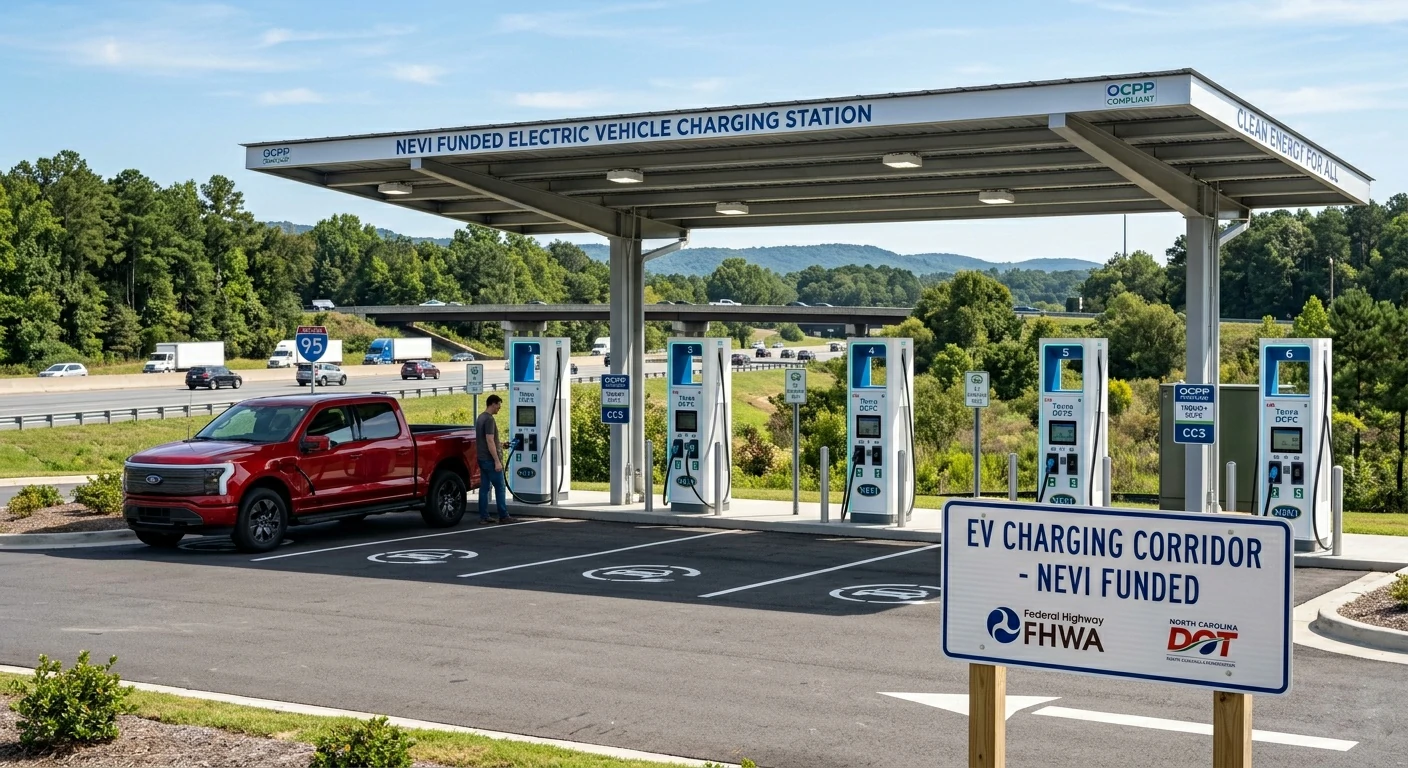
The National Electric Vehicle Infrastructure (NEVI) program remains the largest federal funding source for public charging. It provides up to 80% of eligible project costs on qualifying highway corridor sites, with a 20% host match. The $5 billion program is in its final year of allocations, and several states are still issuing rounds. If your site sits near a designated corridor, check your state DOT’s current round. See the DOE’s NEVI program overview for eligibility details.
State Rebates and Utility Make-Ready Programs
State and utility programs now do the heavy lifting that 30C used to do:
- Utility make-ready programs cover a share of upstream electrical infrastructure. For example, SCE’s Charge Ready program in California offsets $15,000 to $50,000 per port, and Con Edison’s PowerReady program in New York covers make-ready work and hardware.
- State rebates typically range from $200 to $1,000 or more per port, with commercial programs going higher. ComEd in Illinois, for instance, offers up to $2,500 per port in some service areas.
- Stacking these with NEVI and local programs can reduce net project costs by 20% to 50%.
For a detailed breakdown of available programs, see our regional EV charger funding guide.
International Deployments
Sites outside the US: the incentive programs above don’t apply. Your cost drivers are import duties, local certifications, and regional tariff structures instead. Klitv exports to 40+ countries across Southeast Asia, Europe, the Middle East, and Latin America, and our in-house team handles CE and IEC 61851 export documentation. See our Germany Autobahn highway charging project for a European deployment example.
One thing does carry over: the hardware prices in this guide are China factory-direct, so they hold for buyers in any region. The installation figures are US-market numbers. Local wiring, permitting, and labor costs will differ by country. Contact our team early in your planning process to identify the certifications and duties that apply to your region.
Next Steps
Every commercial EV charging project starts with two things: understanding your site’s electrical capacity and knowing your target utilization. From there, you can model costs, evaluate hardware, and choose between owner-funded, financed, and service-based models.
If your site has high traffic and you have the capital budget, owner-funded deployment lets you capture 100% of revenue. If traffic is uncertain or capital is tight, compare Charging-as-a-Service providers. The hybrid model, partial self-funding with a service partner, works well for mixed-use properties with moderate utilization.
Whatever path you choose, plan around utility timelines. DCFC projects can take 9 to 18 months from planning to commissioning. With 30C gone, the most reliable ways to reduce your EV charging station installation cost are disciplined site planning, load management to avoid upgrades, multi-port deployment to share fixed costs, and certified hardware that won’t fail early.
Browse Klitv’s full charger range to compare specifications, or contact our engineering team for a firm quote on your project. We respond to RFQs within 2 working hours.