
In North America, NACS (SAE J3400) has decisively won the charging standards war. Every major automaker is transitioning by 2026, and NACS now powers over 48% of U.S. DC fast-charging connectors. Across Europe, CCS2 remains the mandatory and universal standard with no sign of changing. CHAdeMO, the pioneering standard that launched DC fast charging in 2010, is being phased out in Western markets but still dominates Japan.
Meanwhile, China’s GB/T runs its own separate ecosystem across the world’s largest EV market. Here is what charging station operators, fleet managers, and EV buyers need to know to make the right infrastructure decisions in 2026.
When Markus, a Frankfurt-based charging network operator, ordered his first batch of DC fast chargers in early 2025 for a highway corridor project spanning Germany and Poland, he assumed one connector type would cover his needs. Two weeks before installation, his engineering team flagged a critical oversight: the Polish site sat near a border crossing frequented by Ukrainian trucks running GB/T ports, while his German stations needed to serve a growing number of North American tourists driving NACS-equipped rental EVs. Markus ended up reconfiguring his entire hardware order, adding dual-connector dispensers and pushing his launch date back by three months. The lesson was expensive but clear: connector strategy is no longer a footnote; it is the foundation of any charging infrastructure investment.
The global EV charging connector landscape has never been more fragmented, or more consequential for operators writing seven-figure deployment checks. Whether you are planning a commercial charging hub in Texas, a fleet depot in Rotterdam, or a mixed-use development in Osaka, your connector choices determine station utilization, regulatory compliance, and long-term asset value. This guide provides the technical comparisons, regional deployment strategies, and practical recommendations you need.
Key Takeaways
- NACS (SAE J3400) now dominates North America with 48%+ of U. S. DC fast-charging connectors and near-universal automaker adoption, but CCS1 will remain in active service through at least 2030
- CCS2 is the mandatory, future-proof standard for Europe, UK, Australia, and much of Asia, even Tesla uses it natively in these markets
- CHAdeMO is being phased out in North America and Europe but remains dominant in Japan (~14,500 connectors vs. ~1,200 NACS); its native V2G capability is its lasting technical contribution
- For new charging station deployments in 2026: install dual-port NACS + CCS1 in North America, CCS2 in Europe, and skip new CHAdeMO hardware unless serving Japanese-market vehicles
- The complete transition to NACS in North America is unlikely before 2031, adapters and dual-standard stations are the practical bridge strategy for operators
EV Charging Connector Standards at a Glance
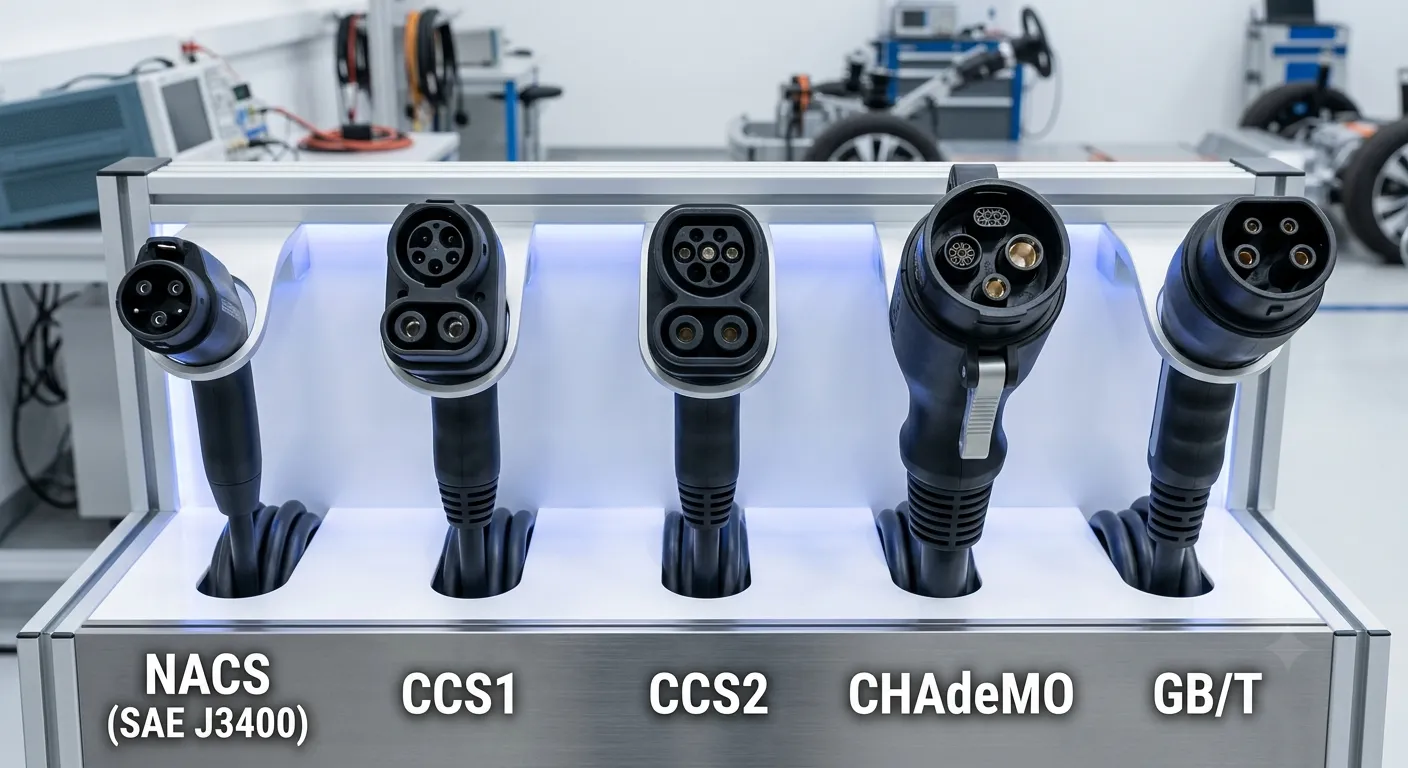
Before diving into head-to-head comparisons, it helps to understand what each standard actually is, its origins, physical design, and current market position.
NACS (North American Charging Standard / SAE J3400)
NACS began as Tesla’s proprietary connector, introduced with the Model S in 2012. In November 2022, Tesla opened the design to the industry, and SAE International standardized it as J3400 in 2023–2024. The connector uses a single slim port, roughly 40% smaller and lighter than CCS1, that handles both AC home charging and DC fast charging through the same inlet. V3 Superchargers deliver up to 250 kW, V4 units reach 350 kW, and the J3400 specification supports up to 1 MW with active cooling.
The real story behind NACS is reliability. Ford CEO Jim Farley cited Tesla’s Supercharger network uptime, consistently above 99%, as a decisive factor in Ford’s 2023 decision to switch from CCS1. By December 2025, NACS connectors were available at over 72,000 stalls across North America, a 340% increase from two years earlier.
CCS (Combined Charging System, CCS1 & CCS2)
CCS was developed as an open industry standard around 2011–2012 by a consortium of German automakers plus GM and Ford. It comes in two variants. CCS1 (North America) adds two large DC power pins below the standard J1772 AC connector, creating a bulky but functional “combo” plug. CCS2 (Europe) does the same below the Type 2 (Mennekes) AC plug and adds three-phase AC support, a critical feature for European electrical infrastructure. Both variants support up to 350 kW commercially, with specifications rated to 500 A and 1,000 V.
CCS1 remains the largest installed base of DC fast-charging connectors in North America, though NACS is closing the gap rapidly. CCS2 is mandated by EU regulation for all public DC chargers and is the default standard across Europe, the UK, Australia, India, and much of the Middle East. Globally, CCS held 42.25% of connector market share in 2024.
CHAdeMO (CHArge de MOve)
CHAdeMO was the world’s first widely deployed DC fast-charging standard, developed in Japan around 2009–2010 by TEPCO and Japanese automakers including Nissan, Mitsubishi, and Toyota. Its name is a play on “Charge de Move”, and also a Japanese pun meaning “How about a cup of tea?” (reflecting the promise of fast charging).
The standard uses a large, round, 10-pin connector with a distinctive locking lever. Original installations delivered 50–62.5 kW at 500 V / 125 A, though the 2.0 specification supports up to 400 kW in theory. CHAdeMO’s standout technical feature is native bidirectional charging (V2G/V2H), which enables vehicles like the Nissan Leaf to power homes during outages, a capability CCS only added later through ISO 15118.
The Fourth Player: GB/T in China
No global connector comparison is complete without acknowledging GB/T, China’s national standard and the most widely deployed charging connector in the world by unit count. China operates over 4 million public charging stations (83.1% of the global total as of May 2026). GB/T uses physically separate AC and DC connectors, unlike the combined approach of CCS and NACS, and is largely incompatible with other standards without adapters. Chinese automakers exporting to CCS2 markets (BYD, NIO, Xpeng) produce region-specific variants rather than exporting GB/T ports.
Technical Specifications Comparison
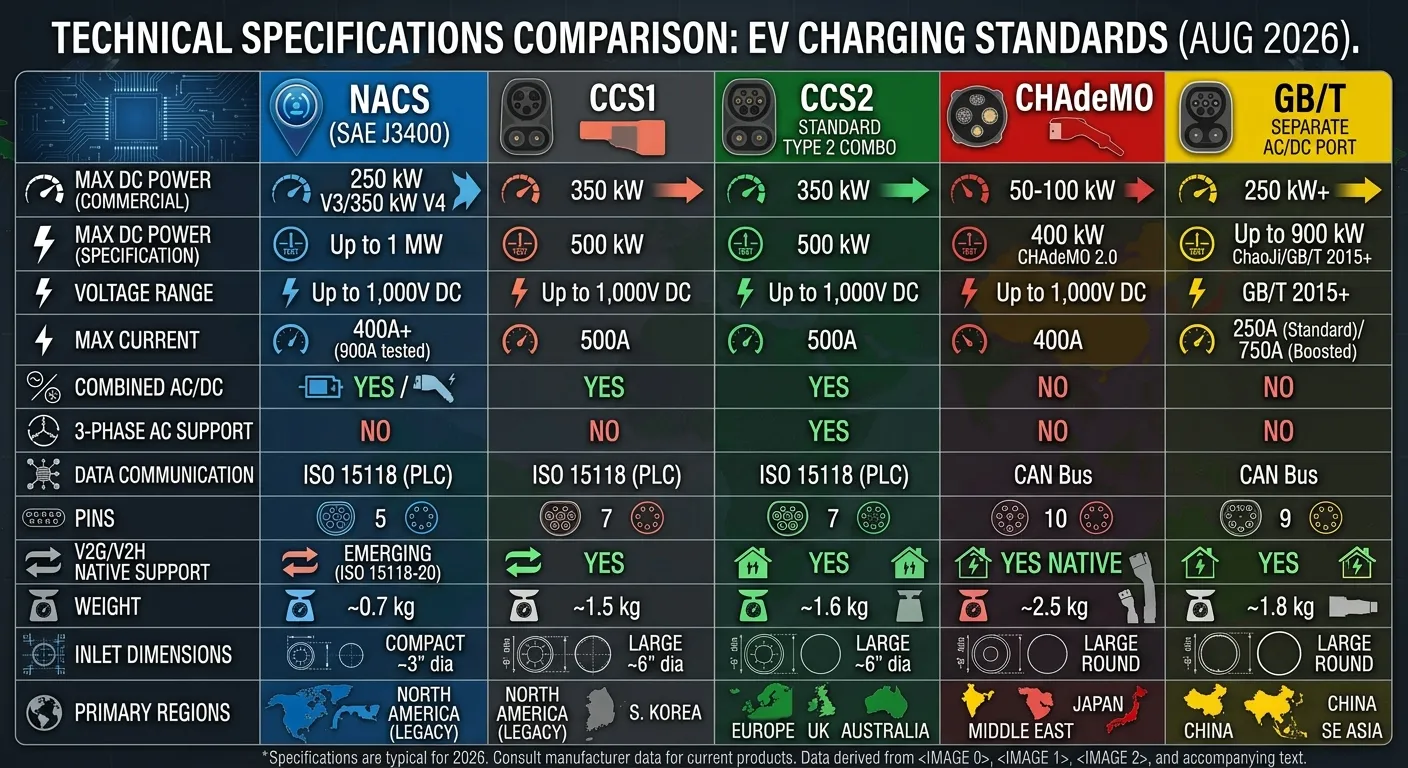
Understanding the numbers behind each standard is essential for operators sizing electrical infrastructure and planning station capabilities.
| Specification | NACS (SAE J3400) | CCS1 | CCS2 | CHAdeMO |
|---|---|---|---|---|
| Max DC Power (Commercial) | 250–350 kW | 350 kW | 350 kW | 50–100 kW (typical) |
| Max DC Power (Specification) | Up to 1 MW | 500 kW (500A/1000V) | 500 kW (500A/1000V) | 400 kW (CHAdeMO 2.0) |
| Voltage Range | Up to 1,000V DC | Up to 1,000V DC | Up to 1,000V DC | Up to 1,000V DC |
| Max Current | 400A+ (900A tested) | 500A | 500A | 400A |
| AC & DC Combined | Yes, single port | Yes, combo plug | Yes, combo plug | No, separate DC port required |
| 3-Phase AC Support | No (rarely implemented) | No | Yes | No |
| Communication Protocol | ISO 15118 (PLC) | ISO 15118 (PLC) | ISO 15118 (PLC) | CAN bus |
| Plug & Charge Support | Yes | Yes | Yes | Limited |
| Bidirectional (V2G/V2H) | Emerging (ISO 15118-20) | Yes (ISO 15118-20) | Yes (ISO 15118-20) | Yes, native since launch |
| Connector Size | Compact (~3” inlet) | Large (~6” inlet) | Large (~6” inlet) | Large, round, bulky |
| Primary Regions | North America | North America (legacy), S. Korea | Europe, UK, Australia, India, Middle East | Japan (dominant), legacy elsewhere |
Charging Speed: What the Numbers Actually Mean
The kW rating on a charger nameplate and what your vehicle actually receives are two very different things. 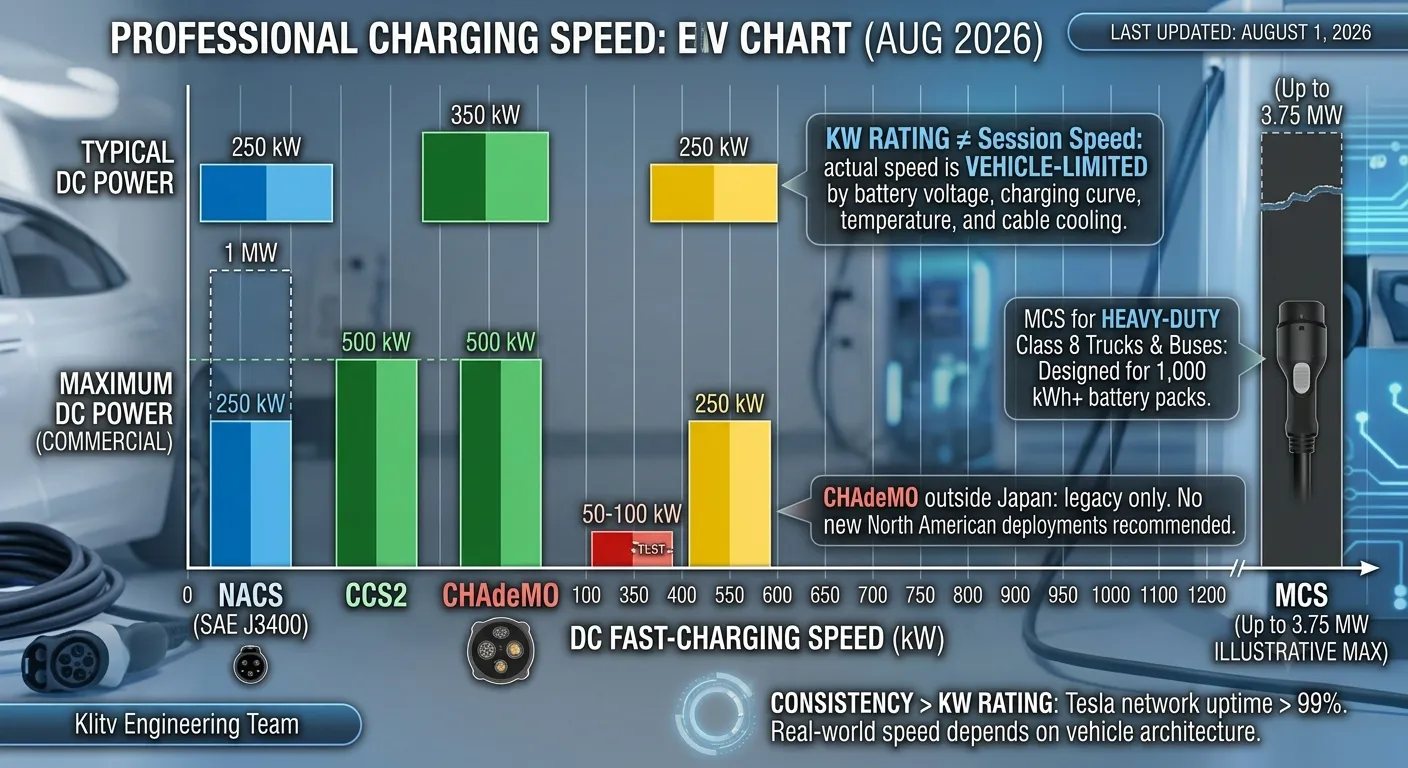
A 350 kW dispenser does not guarantee a 350 kW session, actual charging speed depends on the vehicle’s battery voltage architecture, its charging curve, cable temperature, and ambient conditions.
In real-world testing, 800V-architecture vehicles like the Hyundai Ioniq 5 and Kia EV9 often charge faster on CCS1 stations (which have supported 1,000V for over a decade) than on current Tesla V3 Superchargers, which were originally designed around 400V battery packs. Tesla’s V4 Superchargers address this gap, but network-wide deployment is still underway. For operators, the practical takeaway is clear: connector type alone does not determine charging speed, station power electronics, cable cooling, and grid supply are equally important.
Communication Protocols: Why They Matter for Operators
One of the most overlooked differences between these standards sits at the software layer. CCS and NACS both use Power Line Communication (PLC) based on ISO 15118, which supports Plug & Charge (automatic authentication without an app or RFID card), encrypted communication, and smart charging profiles. CHAdeMO uses CAN bus, a proven automotive protocol that enables its native V2G capability but lacks the advanced features of the ISO 15118 ecosystem.
For commercial operators, this has practical implications. A station running CCS or NACS can offer seamless Plug & Charge experiences that match the convenience of Tesla’s walled-garden approach, while integrating with OCPP-compliant charging management systems. CHAdeMO stations require separate communication infrastructure and typically do not support Plug & Charge.
The Great North American Transition: Why NACS Won
The story of how NACS went from one automaker’s proprietary plug to the near-universal North American standard in under three years is unprecedented in automotive history.
The 2023 Tipping Point
The dominoes fell with remarkable speed. In May 2023, Ford became the first major automaker to announce the switch from CCS1 to NACS. CEO Jim Farley publicly cited Tesla’s network reliability as the deciding factor. General Motors followed on June 8 — widely regarded as the moment CCS1’s fate in North America was sealed.
By the end of 2023, Rivian, Volvo, Polestar, Mercedes-Benz, Nissan, Honda, Hyundai, Kia, BMW, Toyota, Subaru, Lucid, and Volkswagen Group had all committed to NACS. Mazda and Stellantis joined in early 2024, bringing coverage to roughly 99% of the U.S. EV market.
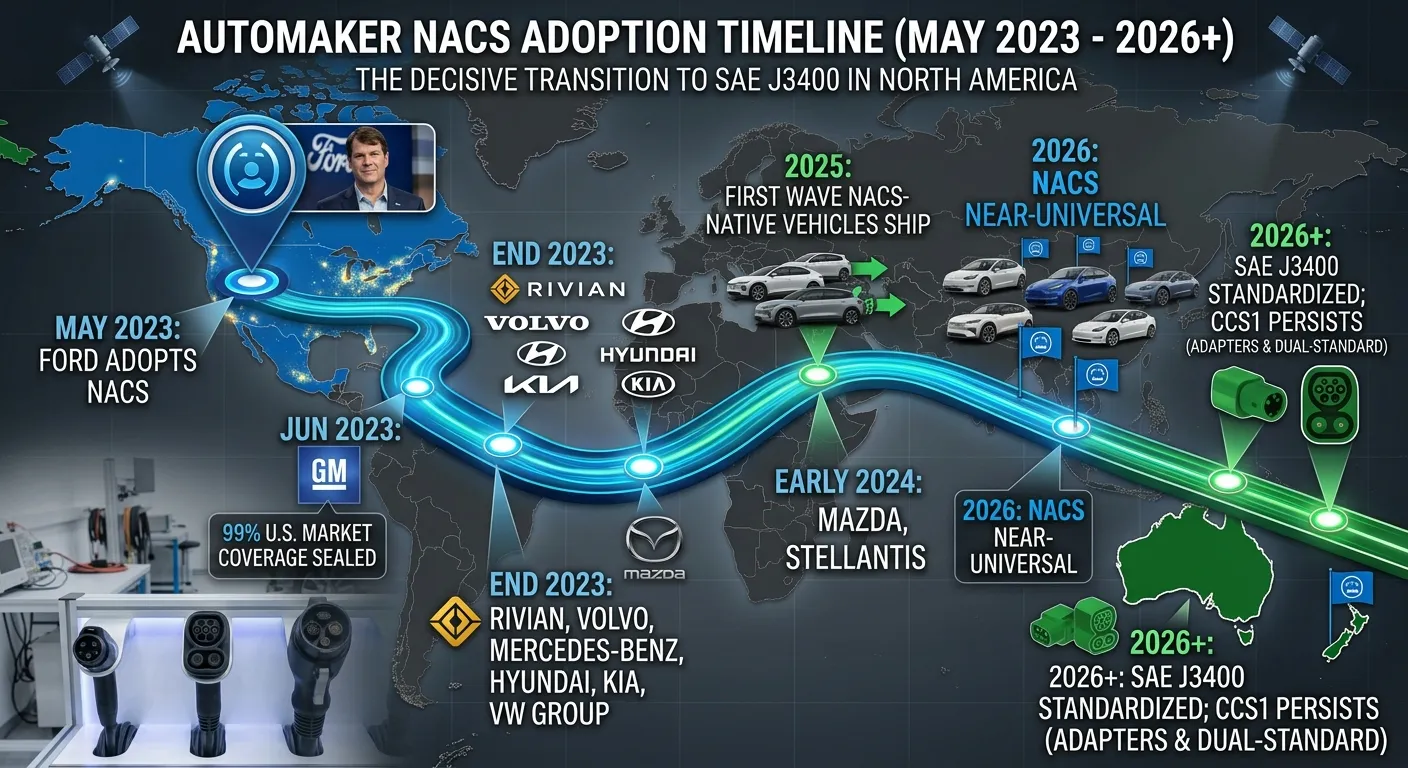
The 2025 model year marked the first wave of vehicles shipping with native NACS ports. By 2026, most new EVs sold in North America arrive with NACS inlets from the factory, and those that do not typically include a manufacturer-supplied adapter.
What Happens to CCS1 Infrastructure?
CCS1 is on a retirement plan; but it is a very long one. As of December 2025, CCS1 still accounted for nearly 40% of U. S. public DC fast-charging connectors, and more new CCS1 chargers were installed during 2025 than NACS chargers (though the gap narrowed significantly throughout the year). Major charging networks including Electrify America, EVgo, and ChargePoint have committed to retrofitting over 18,000 existing CCS1 stalls with dual NACS/CCS1 capability.
The U. S. federal NEVI program still requires CCS connectors on funded stations, though NACS may be added alongside. State-level approaches vary: New Jersey requires both CCS and NACS on each NEVI-funded port, while Illinois caps adapter reimbursement at $200 per port. The estimated cost to retrofit all CCS/J1772 infrastructure nationally sits at $660 million or more, which is why regulators and industry groups treat adapters as a strategic bridge, not a temporary fix.
For charging station operators, this means dual-standard deployments are the only sensible path in 2026. Installing NACS-only stations today would lock out millions of existing CCS1 vehicles for years to come.
Regional Guide: Which Standard Dominates Where
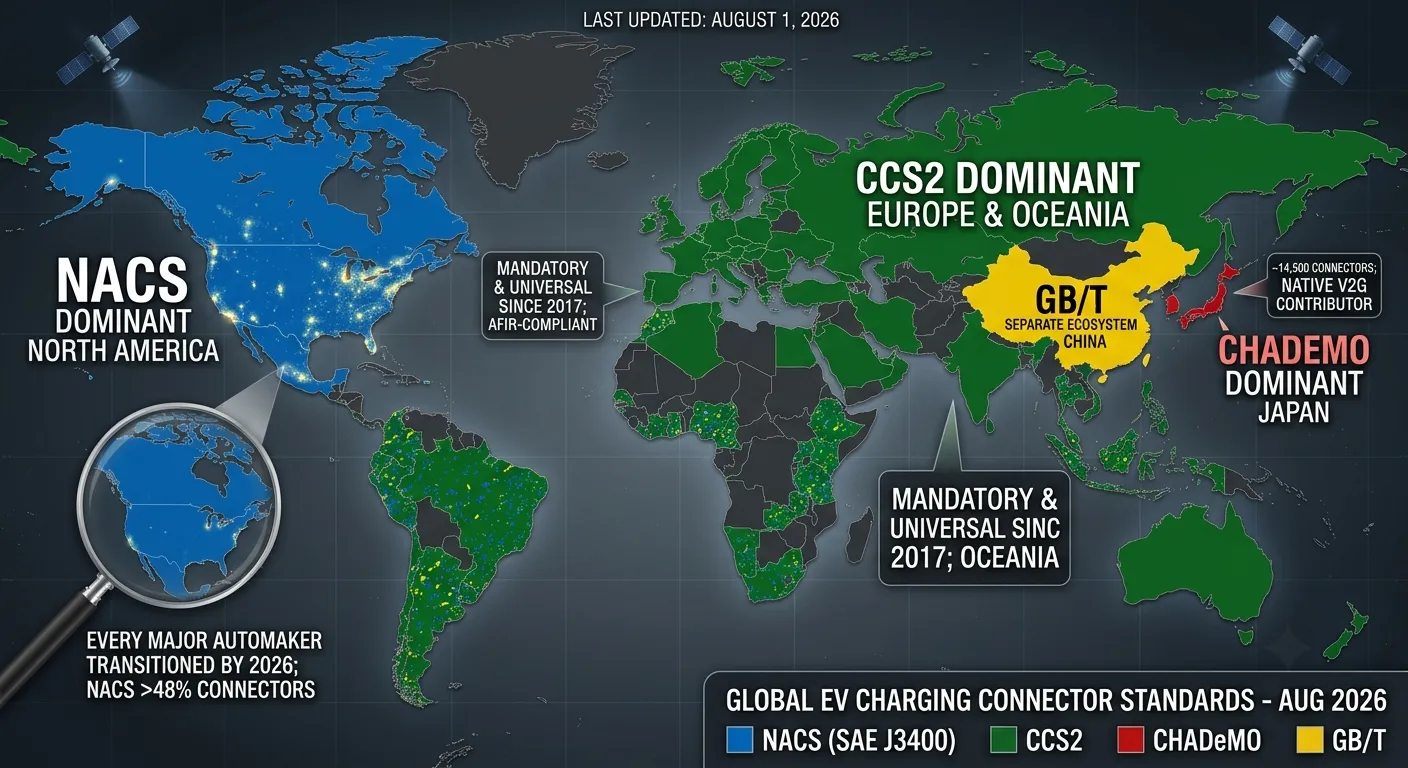
The “global standard” for EV charging does not exist; and may never exist. Here is what operators and buyers need to know by region.
North America: NACS Leads, CCS1 Persists
NACS has won the standards war for new vehicle production, but CCS1’s massive installed base means coexistence through at least 2030. For operators deploying new stations in 2026, the recommended strategy is clear: install dual-port DC dispensers with both NACS and CCS1 cables. For Level 2 AC, NACS-only is increasingly acceptable since most new EVs include CCS1-to-NACS adapters. Skip new CHAdeMO hardware entirely, no major automaker sells a new CHAdeMO-equipped vehicle in North America as of 2026, and existing CHAdeMO stalls are being decommissioned network by network.
Europe & Oceania: CCS2 Is the Only Answer
The EU mandated CCS2 on all public DC chargers from 2017, and the AFIR regulation now requires minimum 150 kW at highway corridor stations. Every EV sold in Europe, including every Tesla, uses CCS2 natively. The ecosystem is fully interoperable: any EV can charge at any station. NACS is not coming to European three-phase electrical markets, and CHAdeMO represents less than 15% of newly installed fast chargers and declining. For operators in Europe, CCS2-only deployments are both compliant and future-proof.
Japan: CHAdeMO’s Last Stronghold
Japan presents a unique picture. As of January 2026, the country had 14,482 CHAdeMO connectors versus just 1,172 NACS Supercharger connectors. Government subsidies have historically favored CHAdeMO deployment, and vehicles like the Nissan Leaf and Mitsubishi Outlander PHEV continue to use it domestically. However, change is coming: Mazda announced in May 2025 that it would adopt NACS for future EVs, and the ChaoJi next-generation standard (jointly developed by China and Japan, targeting up to 900 kW) faces repeated delays with mass production not expected before 2029–2030. For operators in Japan, CHAdeMO remains essential for now, but plan for NACS expansion over the next five years.
China: GB/T’s Separate Path
China’s GB/T standard operates in its own ecosystem, with over 4 million public charging points, 83% of the global total. Chinese EV exports to CCS2 markets use region-specific ports, and GB/T is unlikely to expand beyond domestic and Belt & Road project applications. For international operators, GB/T is not a deployment consideration unless building infrastructure specifically for Chinese-market vehicles.
Emerging Markets: Which Standard to Choose
For operators deploying charging infrastructure in Southeast Asia, Latin America, Africa, or the Middle East, CCS2 is the safest baseline standard. It is already mandated or dominant in India, Australia, Thailand, and South Africa, and European and Korean automakers overwhelmingly ship CCS2-equipped vehicles to these regions. Dual-standard deployments (adding NACS or GB/T) only make sense where specific fleet requirements or cross-border traffic patterns justify the 15–35% additional hardware cost.
What Charging Station Operators Should Install in 2026
This section is the practical core of this guide, the deployment recommendations that translate connector comparisons into procurement decisions.
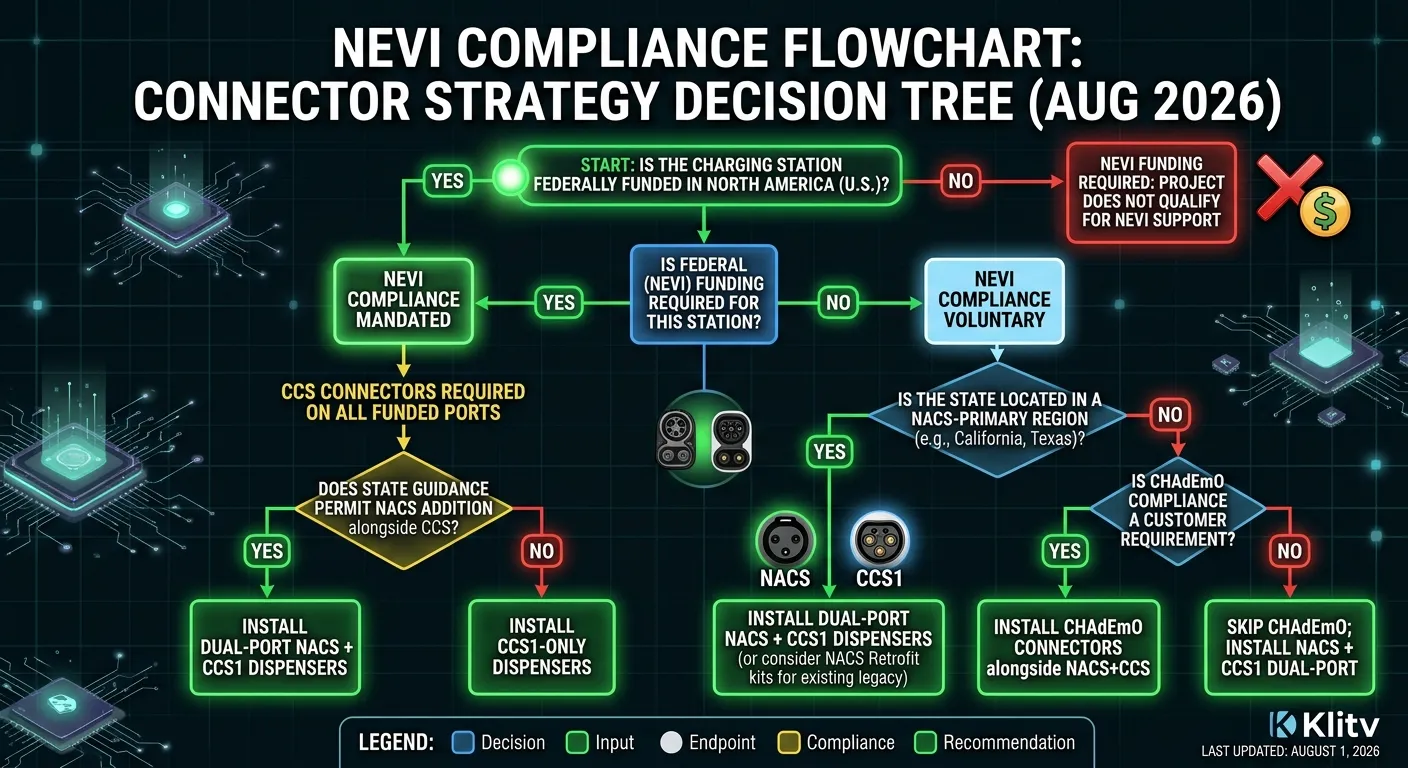
When Ana’s development firm won a contract to build three municipal charging hubs across Southern California in January 2026, her initial plan called for NACS-only hardware to match the wave of new vehicles arriving in showrooms. Her electrical contractor pushed back, pointing out that roughly half the EVs currently on California roads still use CCS1, and that NEVI co-funding required CCS connectors on every port. Ana revised the order to dual-port NACS + CCS1 dispensers with dynamic load balancing across the site. The change added about 18% to hardware cost but preserved access for the entire existing EV fleet, secured federal funding eligibility, and future-proofed the sites through at least 2031.
North America: Dual-Port NACS + CCS1 Strategy
For DC fast-charging deployments in the U. S. and Canada, install dispensers with both NACS and CCS1 cables on every port. This captures the growing NACS-native fleet while maintaining compatibility with millions of legacy CCS1 vehicles. Key considerations:
- NEVI compliance: If you are applying for federal funding, CCS connectors are still required on every funded port. NACS can be added alongside but not substituted. Check your state’s specific guidance, requirements vary significantly.
- Power architecture: Plan for 150 kW minimum per port to meet current driver expectations. Sites along highway corridors should target 250–350 kW to serve next-generation vehicles.
- Future-proofing: Select modular hardware that supports cable swaps and power upgrades. Many current-generation dispensers can be field-retrofitted from CCS1-only to dual-standard, protecting your capital investment as the transition progresses.
Europe: CCS2 Is Mandatory
EU AFIR regulation requires CCS2 on all publicly accessible DC fast chargers. CHAdeMO is optional and declining, most operators no longer include it on new equipment unless specifically requested by a fleet customer with legacy Japanese vehicles. The key decision for European operators is not which connector standard, but which power tier and how many ports per site.
Retrofitting Existing Stations
If you already operate CCS1 or CHAdeMO stations in North America, retrofit options exist. ChargePoint, for instance, documents field procedures for replacing CHAdeMO cables with NACS on existing Express 250 hardware. Network operators including Electrify America and EVgo are executing multi-year retrofit programs across thousands of stalls. Before retrofitting, verify that your existing power electronics can support the target output, older 50 kW CHAdeMO cabinets typically cannot be upgraded to 150 kW+ NACS without replacing the entire power module.
Planning a new commercial charging deployment? Explore Klitv’s full range of DC fast chargers with configurable connector options engineered for global project requirements.
EV Buyer’s Guide: Which Connector Should Your Next EV Have?
If you are buying a new EV in 2026, the connector decision is simpler than it appears, but regional context matters.
North American Buyers: Go NACS-Native
Buy a vehicle with a factory NACS inlet. You get native access to the Tesla Supercharger network, the largest, most reliable DC fast-charging network in North America with 99%+ uptime, plus the ability to charge at any CCS1 station with a compact, affordable adapter. Vehicles still shipping with CCS1 inlets (primarily some Volkswagen Group models and remaining inventory) will need a NACS-to-CCS1 adapter for Supercharger access. These adapters cost $170–$400 and work reliably, but a native connection is always more convenient.
European Buyers: CCS2 Is All You Need
Every new EV sold in Europe uses CCS2 for DC fast charging and Type 2 (Mennekes) for AC. The network is fully interoperable. You will never need to think about connector compatibility at any public station on the continent.
CHAdeMO Vehicle Buyers: Know the Limitations
Used Nissan Leafs and Mitsubishi Outlander PHEVs are the only widely available CHAdeMO vehicles. They can be excellent value for city commuters with home charging, but DC fast-charging availability is shrinking, Electrify America stopped installing new CHAdeMO connectors in 2022, and many networks are actively decommissioning existing CHAdeMO stalls. If you rely on public DC fast charging, a CHAdeMO vehicle is no longer a practical choice outside Japan.
The Future of EV Charging Connectors
The connector story does not end with NACS and CCS2. Three developments will shape the next five years.
MCS (Megawatt Charging System) for Heavy-Duty Vehicles
CharIN’s Megawatt Charging System (MCS) targets power levels from 600 kW to 3.75 MW. It is designed specifically for Class 8 electric trucks, buses, and heavy equipment. A long-haul electric truck with a 1,000 kWh battery pack needs roughly 1.2 MW to restore 400 km of range within a mandatory 30-to-45-minute driver rest window — far beyond what NACS or CCS can deliver.
Major truck OEMs including Daimler Truck, Volvo Trucks, and PACCAR have committed to MCS. Early commercial installations are appearing at highway truck stops and distribution centers, with SAE J3271 standardization underway. The MCS market is projected to grow from roughly $1 billion in 2026 to over $3 billion by 2032.
Will There Ever Be a Single Global Standard?
The short answer is no, at least not within the next decade. Regional electrical infrastructure, regulatory frameworks, and industrial policy are too divergent. The realistic endpoint is regional consolidation: NACS in North America, CCS2 in Europe and most of Asia-Pacific, GB/T in China, with MCS emerging globally for heavy-duty applications. Organizations like CharIN are working to ensure interoperability between CCS and MCS, but full harmonization across all regions and vehicle classes is a long-term aspiration, not a near-term plan.
2026–2030 Predictions
- 2026–2027: NACS becomes the majority of new DC fast-charging ports installed in North America; CCS1 installation share continues to decline; MCS pilot deployments scale at major logistics hubs
- 2028–2029: Dual-standard (NACS + CCS1) stations approach NACS-dominant configurations in North America; CHAdeMO outside Japan becomes niche/legacy only; ChaoJi standard either achieves commercial viability or is abandoned
- 2030: Complete NACS dominance in North American new deployments; CCS2 remains entrenched in Europe; MCS infrastructure reaches highway corridors; adapter ecosystem matures to handle remaining cross-standard edge cases
David, a fleet manager for a midwestern U.S. logistics company with 120 electric delivery vans, faced a connector strategy decision in April 2026. His existing fleet used CCS1 — reliable, familiar, and fully depreciated. But his new van order for 2027 delivery would come with NACS inlets from the factory.
Rather than operate two incompatible charging systems, David worked with his hardware supplier to install dual-port NACS + CCS1 dispensers at his depot, funded partially through a state fleet electrification grant. The dual-standard approach let him continue charging his existing CCS1 fleet at full speed. His depot was already NACS-ready for new vehicle deliveries — no retrofits, no stranded assets, no downtime.
Making the Right Connector Decision for Your Project
The CCS vs CHAdeMO vs NACS landscape in 2026 boils down to one principle: match your connector strategy to your region, your timeline, and your customers’ vehicles. For North American operators, dual-standard NACS + CCS1 deployments are the only approach that protects existing revenue while capturing future growth. For European operators, CCS2 is the entire answer. For Japanese operators, CHAdeMO remains essential today with NACS on the horizon. And for anyone deploying charging infrastructure on a timeline that extends past 2030, the Megawatt Charging System deserves a place in your long-term site planning, especially if heavy-duty vehicles will ever use your stations.
Klitv has supported charging station projects across Germany, Thailand, Dubai, Ghana, and beyond — each with its own regional connector requirements, grid conditions, and compliance standards.
Our DC fast chargers from 20 kW to 720 kW are available with CCS, CHAdeMO, and NACS connector configurations. Every unit is built on a foundation of 2.0mm thickened steel bodies, high-precision components, and industrial-grade packaging that ensures safe delivery to project sites anywhere in the world. With over 800 engineers providing installation guidance, we help operators deploy the right connector strategy for their market and get charging infrastructure online faster.
Ready to plan your charging station deployment? Contact our engineering team for a technical consultation tailored to your project’s location, power requirements, and connector needs.