
Best EV Charger 2026: Home & Commercial Buying Guide
The best EV charger in 2026 depends entirely on your use case: for home charging, the ChargePoint Home Flex delivers the most refined app experience with detailed cost tracking, while the Emporia EV Charger offers the strongest value with built-in load management. For commercial projects and charging station operators, the priority shifts from upfront price to manufacturing quality, global certifications, and after-sales support — areas where Klitv’s one-stop intelligent charging solutions provide a measurable advantage.
Last November, David Chen stood in a half-finished parking lot in Frankfurt, staring at two shipping containers of EV chargers that had arrived with cracked housings and corroded connectors. Sea salt and rough handling had destroyed 30% of his order. His highway charging station project, already three months behind schedule, would now miss the summer travel season entirely. The chargers he’d selected had all the right specs on paper. What the spec sheet didn’t mention: the manufacturer had never shipped a container overseas, used standard cardboard packaging for a 40-day sea voyage, and had no engineers available to help with commissioning.
David’s story isn’t unusual. According to ChargerHelp annual buyer report, more than 20% of operators report hardware failures traceable to shipping damage or manufacturing defects. According to The Business Research Company, the global EV charger market surged past $14.8 billion in 2025 and is projected to reach $47 billion by 2030. This rapid expansion means thousands of new buyers — homeowners, property developers, fleet operators — are making charger purchasing decisions for the first time. Yet most “best EV charger” guidance available online covers only one narrow slice of this market: the residential Level 2 unit you plug into your garage wall. If you’re searching for a best home EV charger, the existing roundups serve you well. If you need a best commercial EV charger or are evaluating a commercial EV charging station for a multi-site deployment, the same guides fall short.
This ev charger buying guide takes a broader view. We cover the top home chargers that consumer publications recommend, then go deeper into what commercial buyers and project developers need to evaluate: manufacturing quality, certification portfolios, global deployment readiness, and long-term support infrastructure. Whether you are buying one charger for your driveway or 200 for a charging network, the goal is the same — equipment that performs reliably, year after year, without surprises.
Key Takeaways
- For home use, the ChargePoint Home Flex ($549) leads on app quality and cost tracking, while the Emporia EV Charger ($429) delivers the best price-to-feature ratio with built-in load management and solar integration.
- For commercial deployments, the decision framework shifts: prioritize factory certifications (UL, CE, IEC 61851), OCPP compliance, manufacturing scale, and regional after-sales support over the lowest per-unit price.
- The global commercial EV charger market is growing at 25%+ annually. Selecting a manufacturer with proven global delivery capability and 800+ engineering support staff directly reduces project risk and deployment delays.
- DC fast chargers (60 kW to 360 kW) are the backbone of commercial corridors. Look for modular designs, liquid cooling above 360 kW, and OCPP 2.0.1 compatibility to avoid vendor lock-in.
- A charger’s purchase price represents roughly 30–40% of its lifetime cost. Installation, maintenance, energy demand charges, and uptime determine whether a project turns profitable.
Best EV Chargers at a Glance: Top Picks by Use Case
The table below covers the full spectrum, from a single home charger to the equipment powering a highway charging hub.
| Use Case | Top Pick | Power | Key Advantage |
|---|---|---|---|
| Best Home Smart Charger | ChargePoint Home Flex | 12 kW (50A) | Best-in-class app, utility rate cost tracking |
| Best Value Home Charger | Emporia EV Charger | 11.5 kW (48A) | Load management + solar integration at $429 |
| Best for Mixed-EV Homes | Tesla Universal Wall Connector | 11.5 kW (48A) | Built-in NACS-to-J1772 adapter |
| Best Durable Home Charger | Grizzl-E Classic | 9.6 kW (40A) | IP67-rated aluminum enclosure |
| Best Commercial AC (7kW) | Klitv 7kW AC Charging Pile | 7 kW | Industrial-grade build, smart management |
| Best Commercial DC (60–80kW) | Klitv 60–80kW DC Charging Pile | 60–80 kW | Modular high-precision parts, OCPP compliant |
| Best High-Power DC (120–180kW) | Klitv 120–180kW DC Charging Pile | 120–180 kW | Highway corridors, fleet depots |
| Best Ultra-Fast DC (360kW+) | Klitv 360–720kW Liquid-Cooled Supercharger | 360–720 kW | Liquid cooling, heavy-duty continuous operation |
Best Home EV Chargers
Consumer publications like Car and Driver and Car Talk have thoroughly tested the current generation of home chargers. If you’re researching a best home EV charger, the ChargePoint Home Flex consistently earns top marks for its polished mobile app, which lets you track charging costs down to the penny using your actual utility rate plan. Its 23-foot cable remains flexible in cold weather, a detail that matters more than most buyers realize until January arrives.
The Emporia EV Charger has emerged as the value leader. At $429, it includes energy monitoring and dynamic load management, features that typically cost $200–300 more from other brands. If your home has an older 100A electrical panel, Emporia’s ability to automatically throttle charging speed can save you the $1,500–$3,000 cost of a panel upgrade.
For households with both a Tesla and a non-Tesla EV, the Tesla Universal Wall Connector solves the connector headache with a built-in, electronically locked J1772 adapter. And for outdoor installations exposed to rain, snow, or salt air, the Grizzl-E Classic, with its IP67-rated cast aluminum housing, remains the most physically durable option available.
Best Commercial & Industrial EV Chargers
Commercial charging equipment operates in a fundamentally different environment than home units. A charger in a hotel parking garage or a highway service plaza may run 24 hours a day, exposed to weather, heavy usage, and varying grid conditions. The requirements shift from “easy app setup” to continuous uptime, remote diagnostics, and multi-standard vehicle compatibility.
Klitv’s commercial lineup spans the full power range that project developers need. The 7kW AC Charging Pile serves workplace and long-stay parking with a 2.0mm thickened steel body built for outdoor exposure. For urban fast-charging hubs, the 60–80kW DC Charging Pile delivers a 20% to 80% charge in approximately 35 minutes, perfectly matched to shopping or dining dwell times. Highway corridors and fleet depots benefit from the 120–180kW DC units, while the 360–720kW Liquid-Cooled Supercharger handles heavy-duty trucks and buses with continuous high-power delivery.
What distinguishes commercial-grade equipment is what you don’t see on a spec sheet: the manufacturing infrastructure behind it. Klitv operates a 20,000㎡ production facility with dedicated R&D and testing laboratories. Every unit ships in industrial-grade wooden crates, not cardboard, to survive ocean freight to project sites worldwide. Over 800 engineers provide online and offline commissioning support, reducing the kind of deployment delays that cost operators real revenue.
Looking for equipment tailored to your project scale? Browse Klitv’s full product range to compare specifications across AC and DC charging solutions.
How to Choose the Right EV Charger: Key Decision Factors
Selecting the best EV charger means matching the equipment to your specific operating conditions, not just picking the highest-rated unit from a consumer review. Here’s how to choose an EV charger that fits your needs — whether you’re a homeowner, fleet manager, or infrastructure developer.
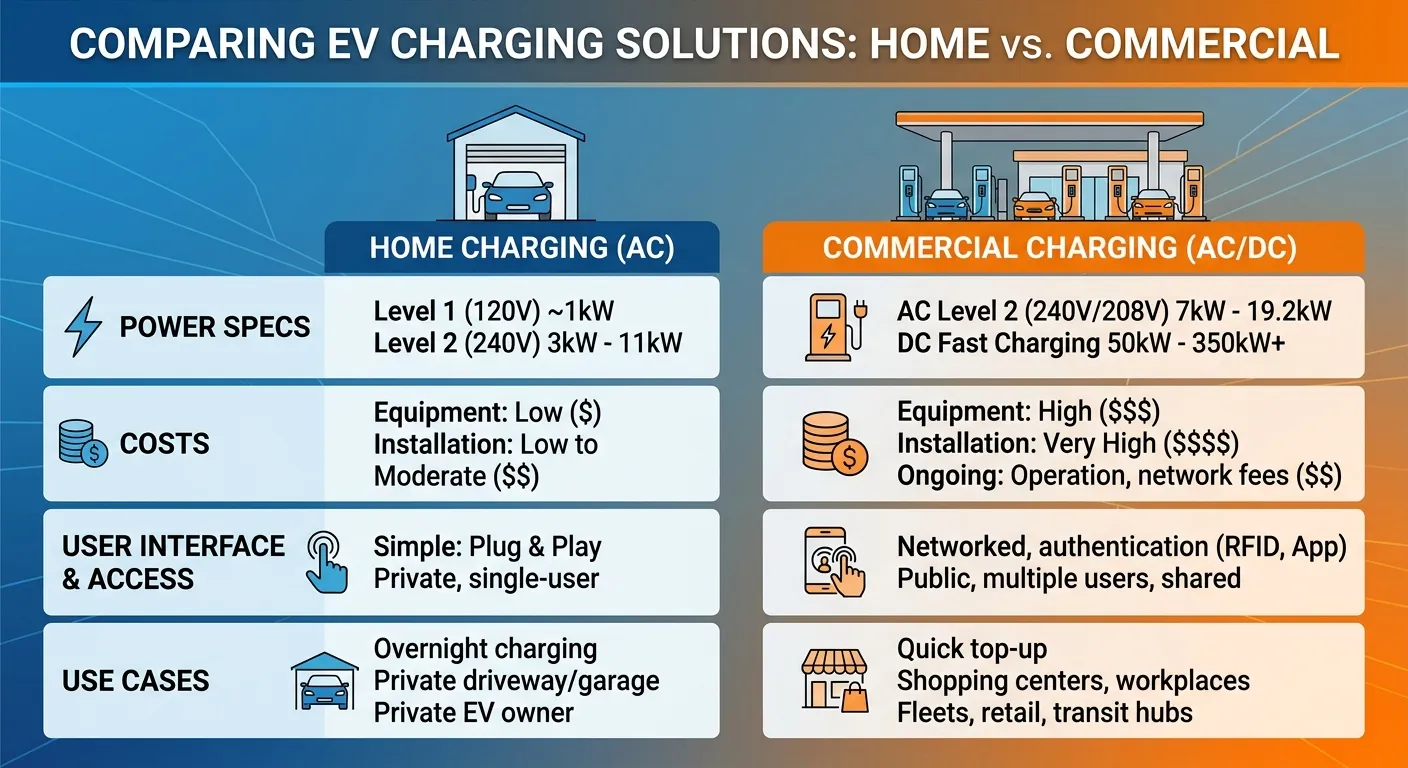
Home vs. Commercial Charging: What’s Actually Different?
Maria Okonkwo runs a 14-unit apartment building in Austin. When she installed two consumer-grade chargers in her parking lot in 2024, she expected them to last five years. Both failed within 18 months. The enclosures, rated NEMA 3R, fine for a suburban garage, couldn’t handle the combination of Texas sun, occasional flooding, and 12–15 daily charging sessions. She replaced them with commercial-rated units and hasn’t had a service call since.
The differences between consumer and commercial chargers are structural:
| Factor | Consumer Charger | Commercial Charger |
|---|---|---|
| Enclosure | Plastic or thin steel, NEMA 3R | 2.0mm+ steel, NEMA 4 / IP54–IP65 |
| Duty Cycle | 2–4 hours/day, intermittent | Up to 24/7 continuous operation |
| Expected Lifespan | 5–8 years | 8–12+ years |
| Certifications | Basic safety (UL listed) | Full suite: UL, CE, IEC 61851, OCPP |
| Support Model | Consumer warranty, email support | Dedicated engineering team, on-site commissioning |
| Packaging | Consumer retail box | Industrial-grade wooden crates for freight |
Charging Levels Explained
Level 1 (120V) adds 3–5 miles of range per hour using a standard household outlet. It works for plug-in hybrids or very low-mileage drivers, but for anyone driving more than 30 miles daily, it’s inadequate.
Level 2 (240V) is the standard for home, workplace, and destination charging. Output ranges from 3.8 kW to 11.5 kW, delivering 15–40 miles of range per hour. A 48A Level 2 charger fully recharges most EVs overnight. This is what 90% of “best EV charger” articles cover.
DC Fast Charging (Level 3) delivers power directly to the battery at 50–350 kW, adding 150+ miles in 20–30 minutes. This is commercial territory: highway rest stops, retail corridors, fleet depots. Installation requires three-phase power, transformer upgrades, and significant civil works — budgets start at $40,000 per unit and can exceed $150,000 for ultra-fast 350 kW+ installations. For a complete technical breakdown, see our Level 3 EV charger guide.
Connector Types: What Works with What
The connector landscape is consolidating. In North America, J1772 remains the standard for non-Tesla EVs. NACS (J3400), originally Tesla’s connector, is being adopted by Ford, GM, Rivian, and most major automakers starting with 2025 model years. In Europe, CCS2 dominates. China uses GB/T. For Japan, CHAdeMO is still present but declining.
For commercial station operators, the practical answer is to deploy multi-standard chargers that support CCS and CHAdeMO simultaneously, with NACS compatibility either built in or available via adapter. Klitv’s DC fast chargers support CCS1, CCS2, CHAdeMO, and GB/T configurations depending on target market, a detail that matters enormously when you are deploying across multiple regions and don’t want to maintain separate equipment inventories.
Smart Features That Actually Matter
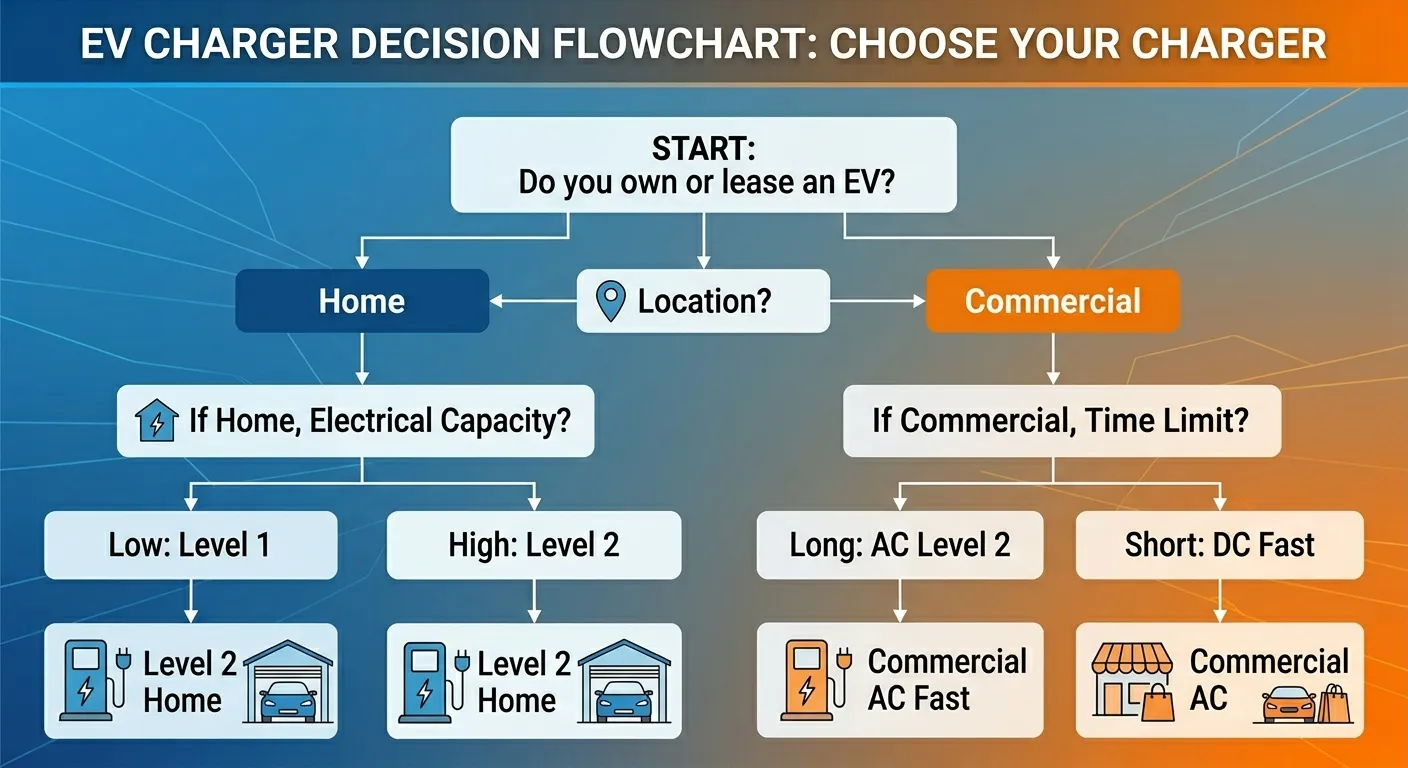
Not every “smart” feature delivers real value. Focus on four capabilities that directly affect operating costs and uptime:
OCPP Compliance, The Open Charge Point Protocol lets your chargers talk to any backend management system. Without OCPP certification, you are locked into one software provider. With it, you can switch platforms, negotiate better rates, or build your own management system. Verify OCPP certification through the Open Charge Alliance, don’t take a manufacturer’s word for it.
Dynamic Load Balancing, For sites with multiple chargers sharing a limited electrical supply, load balancing automatically distributes available power across active charging sessions. This prevents breaker trips and can reduce your peak demand charges by 20–40%.
Remote Monitoring & Diagnostics, Over 50% of commercial charger service calls are resolved remotely when the unit supports full OCPP-based diagnostics. A technician can reset a unit, update firmware, or diagnose a fault without rolling a truck. At $150–300 per site visit, this adds up fast across a network of 50 or 500 stations.
Energy Management & Reporting, Clear per-port energy data simplifies billing, sustainability reporting, and identifying underperforming stations. Klitv’s integrated platform provides app-based scheduling, real-time monitoring, and detailed power reports, tools designed for operators managing multiple sites, not just a single home charger.
For Project Developers: How to Evaluate an EV Charger Manufacturer
This section addresses what no consumer buying guide covers: how to vet a manufacturer when you are spending $50,000 or $5 million on charging equipment.
Manufacturing Quality and Certifications
Visit the factory, or at minimum, request a video tour. A facility under 3,000㎡ with no visible automation is a red flag for orders above 50 units. Look for in-house SMT lines, automated testing stations, and serial-number-level traceability throughout the production process.
Essential certifications by region:
- North America: UL 2594, UL 2231, FCC, Energy Star
- Europe: CE, IEC 61851-1, IEC 61851-23
- Global interoperability: OCPP 1.6J or 2.0.1 (verify through Open Charge Alliance)
- Quality management: ISO 9001
Klitv’s 20,000㎡ facility operates with one dedicated research center and three testing laboratories. High-precision parts, never recycled materials, are verified at multiple QC checkpoints before assembly. Every completed unit undergoes burn-in testing before being packed in industrial-grade wooden crates for shipment.
Global Deployment Readiness
If your project crosses borders, the manufacturer’s logistics capability becomes as important as the hardware itself. Three questions to ask:
-
What packaging do you use for ocean freight? If the answer is “standard packaging,” walk away. Salt air, container condensation, and port handling destroy inadequately packed electronics.
-
How many engineers do you have available for remote and on-site commissioning? A manufacturer with 12 support staff cannot effectively serve projects across three continents.
-
What certifications do you hold for my specific target market? A CE mark alone doesn’t cover North America. A UL listing alone doesn’t cover the Middle East. Get the actual certificate numbers and verify them.
Klitv has shipped charging equipment to projects in Germany, Thailand, and the UAE, among other regions. Each shipment uses industrial-grade wooden crating with protective bracing. The 800-engineer support team provides installation guidance and commissioning support both online and on-site, a capability that directly shortened deployment timelines at the Germany Autobahn highway charging project.
Total Cost of Ownership, Not Just Purchase Price
A $40,000 DC fast charger that runs at 95% uptime for eight years costs less than a $32,000 unit that averages 73% uptime and requires three major repairs. According to ChargerHelp’s Annual Buyer’s Report, the industry average uptime for public charging stations is only 73% — meaning more than a quarter of charging attempts at an average station fail. Choosing the best EV charger for commercial use means prioritizing reliability metrics over the lowest bid.
Calculate TCO across five dimensions:
- Hardware: Purchase price plus shipping and import duties
- Installation: Civil works, electrical upgrades, permits, commissioning
- Energy: Per-kWh electricity cost plus demand charges
- Maintenance: Preventive service, corrective repairs, spare parts inventory
- Software: CSMS subscription, networking fees, payment processing
A charger with higher upfront cost but better reliability and remote diagnostics often produces a lower TCO within 18–24 months of operation.
Red Flags When Vetting Suppliers
- No official OCPP certification listed on the Open Charge Alliance registry
- Inability to provide customer references for projects of similar scale
- No transparency on firmware update policies or cybersecurity practices
- No regional service presence in your target deployment area
- Claims of “OCPP compatibility” without actual certification documents
EV Charger Costs: Home & Commercial Installation Budgets
Home Installation Costs
A typical home Level 2 installation runs $1,200–$3,000 all-in. For a deeper breakdown, refer to our EV charging station installation cost guide.
| Component | Cost Range |
|---|---|
| Charger hardware | $350–$750 |
| Electrician labor | $500–$1,500 |
| Panel upgrade (if needed) | $1,500–$3,000 |
| Permits & inspection | $100–$300 |
The U.S. federal tax credit covers 30% of total project cost (equipment + installation), capped at $1,000. This incentive is set to expire June 30, 2026 — if you’re planning an installation, act before the deadline. Many states and utilities layer additional rebates of $200–$1,300 on top of the federal credit.
Commercial Installation Costs
Commercial projects scale differently because the infrastructure requirements multiply:
| Charger Type | Hardware | Installed Cost (Per Unit) |
|---|---|---|
| Level 2 AC (7–22 kW) | $800–$3,000 | $2,500–$10,000 |
| DC Fast (50–150 kW) | $25,000–$60,000 | $40,000–$100,000 |
| DC Ultra-Fast (350 kW+) | $80,000–$120,000 | $100,000–$150,000+ |
The NEVI (National Electric Vehicle Infrastructure) program provides up to 80% of eligible project costs in the U.S. As of October 2025, 121 NEVI-funded stations were energized across 16 states, according to the U.S. Department of Energy’s Alternative Fuels Data Center. When planning a commercial EV charging station, these incentives can dramatically shift the project economics. For commercial projects outside the U. S., programs like the EU’s Advenir scheme and various national subsidies significantly reduce upfront capital requirements.
ROI: What to Expect
A well-sited commercial DC fast charging station with 25–30% utilization typically reaches payback in 3–5 years. Sites with 40%+ utilization, highway corridors, busy retail centers, can break even in under 3 years. The single biggest variable isn’t the charger hardware cost; it’s uptime. Every hour a station is down during peak traffic is unrecoverable revenue.
Want to model the numbers for your specific site? Use Klitv’s EV charging ROI calculator to run projections based on your local electricity rates, expected utilization, and equipment configuration.
Key Certifications and Standards for EV Chargers
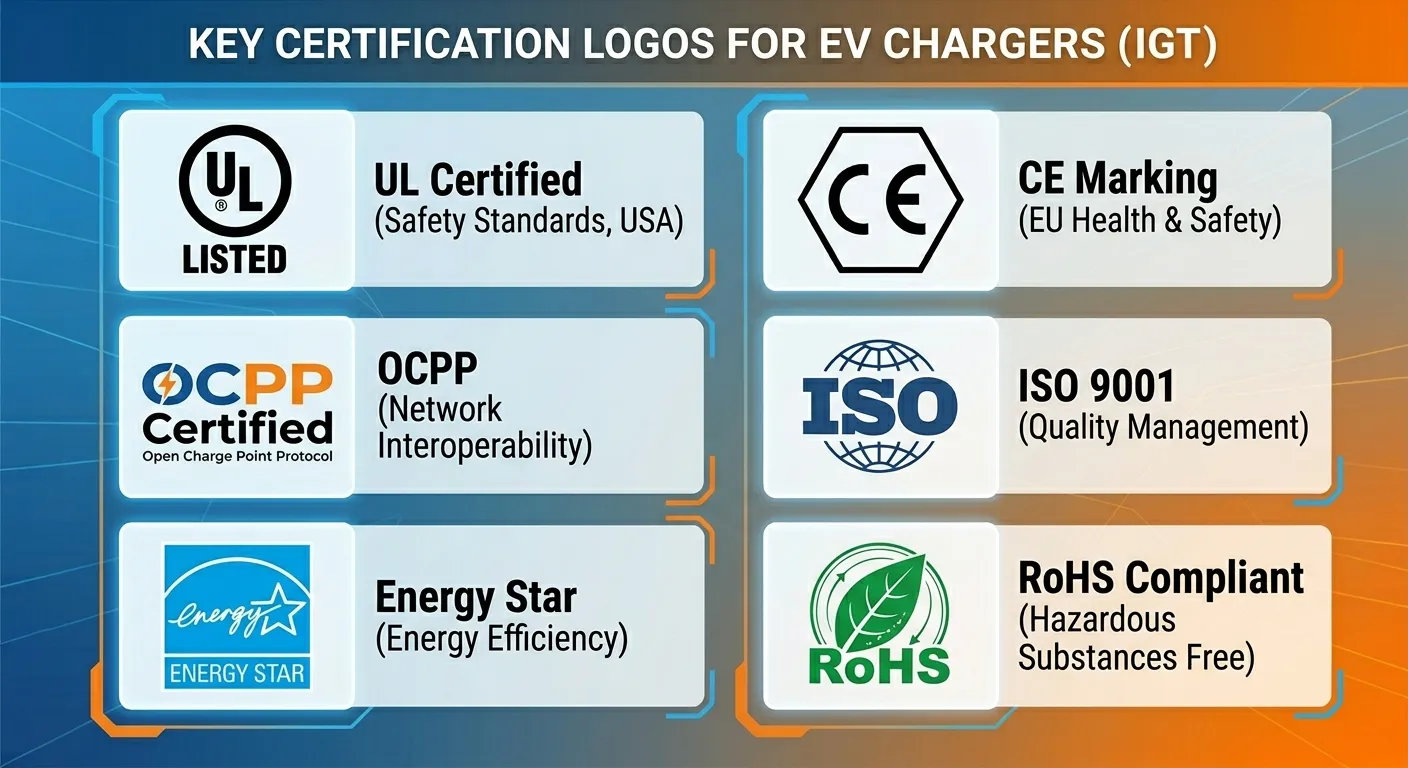
Understanding what certifications matter, and which are merely decorative, protects your investment.
| Certification | What It Covers | Required For |
|---|---|---|
| UL 2594 | Safety standard for EVSE | North America |
| UL 2231 | Personnel protection systems | North America |
| CE / IEC 61851 | Safety and performance | Europe, Middle East, Asia |
| OCPP 1.6J / 2.0.1 | Backend interoperability | All commercial deployments |
| Energy Star | Energy efficiency | Utility rebate eligibility (US) |
| NEMA 3R / 4 | Environmental protection | Outdoor installations |
| IP54 / IP65 | Dust and water ingress | Outdoor installations (global) |
| ISO 15118 | Plug & Charge, V2G | Future-proofing |
OCPP certification deserves special attention. A manufacturer that claims “OCPP compatible” without being listed on the Open Charge Alliance registry may have implemented only a partial version of the protocol. Full OCPP 1.6J or 2.0.1 certification means the charger has passed conformance testing and will integrate reliably with any certified CSMS platform.
Klitv’s commercial chargers hold OCPP 1.6J certification and are built to comply with CE, IEC 61851, and relevant regional standards depending on target market. For a complete discussion of OCPP’s role in commercial charging, see our commercial EV charger deployment guide.